
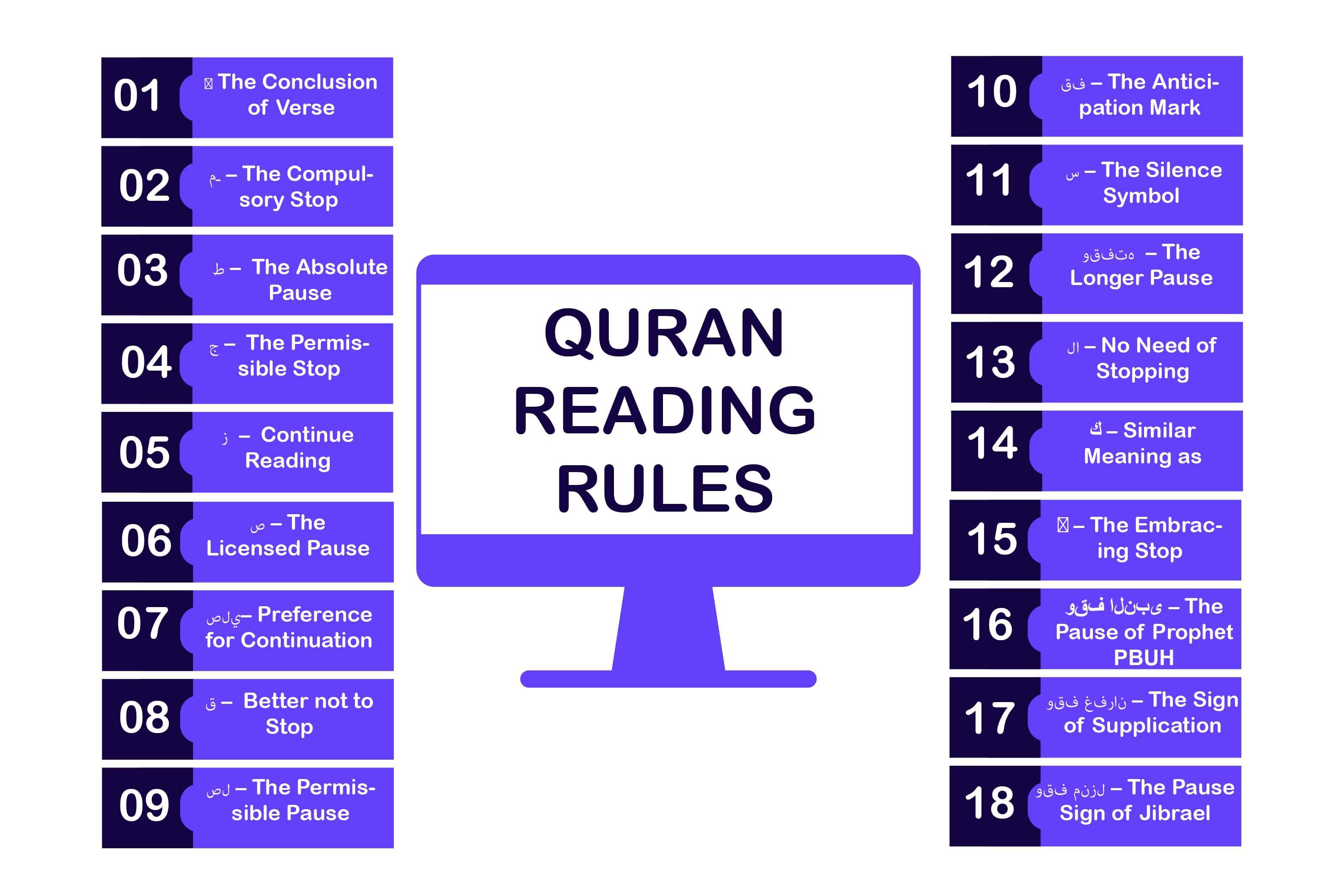



18 Rules of Reading Quran
The Conclusion of Verse:
In the Quran, a verse's conclusion is marked by a subtle pause known as "sukoon." It is encouraged for readers to take a brief moment at the end of a verse, allowing time for reflection on its profound meaning and significance.
To truly immerse oneself in the spiritual resonance of Quranic recitation, it is imperative to recite with accurate pronunciation, intonation, and observe the recommended pauses at appropriate junctures.
مـ – The Compulsory Stop:
The Arabic letter "م" (Meem) holds significance in Quranic recitation as it is one of the letters linked with the obligatory pause, known as "waqf."
This mandatory pause is crucial, as it follows the rules of tajweed, ensuring the correct recitation of specific Quranic verses. Neglecting this pause can potentially alter the intended meaning of the verse.
The compulsory stop can manifest either at the end of a word or within a word, depending on the context and the rules of tajweed.
ط – The Absolute Pause:
In Arabic, the character "ط" is referred to as the "waqf e mutlaq" or the "absolute pause" symbol. This symbol plays a crucial role in the recitation of the Quran, signifying a complete cessation in the reading process.
When encountering this symbol, it is mandatory for the reader to halt briefly, take a breath, and then resume the recitation. This pause holds several significant purposes.
First and foremost, it provides the reader with a momentary respite, allowing them to catch their breath, a particularly valuable practice during extended recitations.
Additionally, this pause aids in establishing a consistent and harmonious rhythm throughout the recitation, helping the reader to maintain a steady pace.
Lastly, it serves as a visual guide, assisting the reader in navigating through the text and reducing the likelihood of mistakes or mispronunciations.
ج – The Permissible Stop:
In Arabic, the character "ج" denotes a permissible pause known as "waqf e jaaiz."
This symbol marks the conclusion of a particular idea or subject within a Quranic verse, prompting the reader to take a brief pause before proceeding. While it is not mandatory to halt at this juncture, doing so is of great importance as it facilitates a deeper comprehension of the preceding verses.
ز – Continue Reading:
In Arabic, the character "ز" serves as a marker for "waqf e mujawwaz," which translates to "continue reading."
This symbol conveys that the reader is encouraged to proceed with reciting the Quran without a pause at this juncture. Nevertheless, it's essential to understand that pausing at this point is not prohibited, and the reader may choose to do so as required.
ص – The Licensed Pause:
In Arabic script, the character "ص" is employed to convey "waqf e murakh-khas," signifying a permissible but selective pause. This particular symbol is distinct from "waqf e jaaiz" and "waqf e mujawwaz" in that it is applied in specific circumstances. It is reserved for instances when the reader is genuinely fatigued or physically exhausted.
When "ص" is encountered, it indicates that the reader has the option to take a brief pause for rest and to catch their breath before resuming the Quranic recitation. It's crucial to emphasize that this pause is to be exercised only when there is a genuine need, and the reader is physically tired. If one is capable of continuing without interruption, it is recommended to do so, as this pause is not to be applied indiscriminately.
صلي– Preference for Continuation:
The Arabic phrase "صلي" introduces the rule of recitation called "al-wasl awlaa," signifying a preference for uninterrupted continuity. This principle emphasizes that it is more favorable to maintain a continuous recitation of the Quran, avoiding unnecessary pauses whenever possible.
ق – Better not to Stop:
The Arabic symbol "ق" introduces a rule of recitation called "qeela 'alayhil-waqf," which translates to "better not to stop." This rule advises a preference for continuous Quran recitation, minimizing unnecessary pauses.
Nevertheless, it's important to acknowledge that there exist varying interpretations among scholars regarding the practical application of this rule. Some scholars contend that there are specific instances within the Quranic text where it is appropriate to briefly pause or stop, even when the "qeela 'alayhil-waqf" sign is present. Such pauses may be justified to convey the intended meaning of the verses more effectively, provide clarification, or emphasize particular points.
صل – The Permissible Pause:
In Arabic, the symbol "صل" signifies a recitation rule known as "qad yusal," which translates to "the permissible pause." This guideline grants the reciter the option to briefly pause at a specific juncture in the recitation, even though the symbol itself suggests continuity.
Crucially, it should be understood that the "qad yusal" sign does not mandate a compulsory halt or pause in the recitation; instead, it permits such pauses at the reader's discretion.
قف – The Anticipation Mark:
In the Arabic language, "قف" or "qif" serves as an anticipation marker employed to signal a pause or cessation within a sentence where the reader might otherwise anticipate a continuous flow of text. It is akin to a period or full stop in English, but its distinct purpose is to convey a pause or break within a sentence that might not be immediately obvious to the reader.
س – The Silence Symbol:
In the Arabic language, the symbol "سكتة" or "saktah" is employed to convey a momentary pause within a sentence, without necessitating an interruption for taking a breath. It bears similarity to a comma or semicolon in English, but its specific function is to denote a brief pause that doesn't entail a need for inhalation.
"Saktah" finds frequent use in formal written and spoken Arabic, serving to establish a sense of cadence and continuity within the sentence. Furthermore, it is employed to signify shifts in emphasis or alterations in the tone of the discourse.
وقفتہ – The Longer Pause:
In the Arabic language, "وقفة" or "waqfah" is a symbol utilized to signify a more extended pause within a sentence, without necessitating an interruption in the sentence's flow. It is analogous to a period or full stop in English, yet its distinctive purpose is to indicate a longer pause that doesn't mandate taking a breath.
لا – No Need of Stopping:
In the context of the Quran, the word "لا" or "laa" is frequently employed to convey negation or denial. Unlike typical Arabic punctuation marks, "laa" does not denote a pause or interruption in the sentence's flow; instead, it serves to emphasize or negate a statement.
It's crucial to understand that when "laa" appears within a Quranic verse, it should not be treated as a punctuation mark that necessitates a pause or halt in the recitation.
ك – Similar Meaning as Previous Sign:
In the Arabic language, the word "كذلك" or "kadhaalik" is employed to convey that the subsequent action or statement is akin to what has been previously mentioned. It can be likened to the English phrases "like that" or "in the same way." This term carries a similar implication of action as that indicated by the "Laa" symbol.
∴ – The Embracing Stop:
In Arabic, this symbol is known as "Mu'anaqah," which translates to "embracing" or "entwining." Mu'anaqah is a diacritical mark positioned on the final letter of a word in the Quran, signifying that the reciter should pause momentarily, take a breath, and then seamlessly continue with the following verse.
The Quran is celebrated for its graceful and exquisite language, and the deliberate use of Mu'anaqah serves to enrich the poetic and rhythmic cadence of its verses.
وقف النبی – The Pause of Prophet PBUH:
"Waqf-un-Nabi," which translates to "the Prophet's pause," is a Sunnah, representing an example set by the Prophet Muhammad (SAW), followed in Quranic recitation. When Muslims recite the Quran, they strive to do so in the same manner as the Prophet Muhammad (SAW) did.
It is documented that the Prophet Muhammad (SAW) would make pauses or stops at particular points during his recitation of the Quran. These pauses were not indicated by any specific symbol or diacritical mark; instead, they were based on the Prophet's own recitation. These pauses are considered an integral part of the Sunnah.
وقف غفران – The Sign of Supplication:
"Waqf e Ghufraan," an Arabic term signifying "a pause for forgiveness," is employed in Islamic texts, including the Quran, to prompt readers to pause and seek forgiveness from Allah. When encountering this symbol during Quranic recitation or while reading Islamic texts, readers should cease reading and offer a brief prayer asking for forgiveness from Allah. This momentary pause serves as an opportunity for reflection on the message and a chance to seek forgiveness for any transgressions committed.
وقف منزل – The Pause Sign of Jibrael:
"Waqf e Manzil," an Arabic term meaning "pause at a designated place," is utilized in the Quran to signify the pauses or stops that the Angel Jibreel would make when revealing Quranic verses to the Prophet Muhammad (PBUH). During the revelation of the Quran to the Prophet Muhammad (PBUH), Angel Jibreel would pause at specific junctures in the recitation. These designated pauses are marked in the Quran with the Waqf e Manzil symbol, signifying to readers that they should likewise pause and engage in reflection.
In the Quran, a verse's conclusion is marked by a subtle pause known as "sukoon." It is encouraged for readers to take a brief moment at the end of a verse, allowing time for reflection on its profound meaning and significance. To truly immerse oneself in the spiritual resonance of Quranic recitation, it is imperative to recite with accurate pronunciation, intonation, and observe the recommended pauses at appropriate junctures.
The Arabic letter "م" (Meem) holds significance in Quranic recitation as it is one of the letters linked with the obligatory pause, known as "waqf." This mandatory pause is crucial, as it follows the rules of tajweed, ensuring the correct recitation of specific Quranic verses. Neglecting this pause can potentially alter the intended meaning of the verse. The compulsory stop can manifest either at the end of a word or within a word, depending on the context and the rules of tajweed.
In Arabic, the character "ط" is referred to as the "waqf e mutlaq" or the "absolute pause" symbol. This symbol plays a crucial role in the recitation of the Quran, signifying a complete cessation in the reading process. When encountering this symbol, it is mandatory for the reader to halt briefly, take a breath, and then resume the recitation. This pause holds several significant purposes. First and foremost, it provides the reader with a momentary respite, allowing them to catch their breath, a particularly valuable practice during extended recitations. Additionally, this pause aids in establishing a consistent and harmonious rhythm throughout the recitation, helping the reader to maintain a steady pace. Lastly, it serves as a visual guide, assisting the reader in navigating through the text and reducing the likelihood of mistakes or mispronunciations.
In Arabic, the character "ج" denotes a permissible pause known as "waqf e jaaiz." This symbol marks the conclusion of a particular idea or subject within a Quranic verse, prompting the reader to take a brief pause before proceeding. While it is not mandatory to halt at this juncture, doing so is of great importance as it facilitates a deeper comprehension of the preceding verses.
In Arabic, the character "ز" serves as a marker for "waqf e mujawwaz," which translates to "continue reading." This symbol conveys that the reader is encouraged to proceed with reciting the Quran without a pause at this juncture. Nevertheless, it's essential to understand that pausing at this point is not prohibited, and the reader may choose to do so as required.
In Arabic script, the character "ص" is employed to convey "waqf e murakh-khas," signifying a permissible but selective pause. This particular symbol is distinct from "waqf e jaaiz" and "waqf e mujawwaz" in that it is applied in specific circumstances. It is reserved for instances when the reader is genuinely fatigued or physically exhausted. When "ص" is encountered, it indicates that the reader has the option to take a brief pause for rest and to catch their breath before resuming the Quranic recitation. It's crucial to emphasize that this pause is to be exercised only when there is a genuine need, and the reader is physically tired. If one is capable of continuing without interruption, it is recommended to do so, as this pause is not to be applied indiscriminately.
The Arabic phrase "صلي" introduces the rule of recitation called "al-wasl awlaa," signifying a preference for uninterrupted continuity. This principle emphasizes that it is more favorable to maintain a continuous recitation of the Quran, avoiding unnecessary pauses whenever possible.
The Arabic symbol "ق" introduces a rule of recitation called "qeela 'alayhil-waqf," which translates to "better not to stop." This rule advises a preference for continuous Quran recitation, minimizing unnecessary pauses. Nevertheless, it's important to acknowledge that there exist varying interpretations among scholars regarding the practical application of this rule. Some scholars contend that there are specific instances within the Quranic text where it is appropriate to briefly pause or stop, even when the "qeela 'alayhil-waqf" sign is present. Such pauses may be justified to convey the intended meaning of the verses more effectively, provide clarification, or emphasize particular points.
In Arabic, the symbol "صل" signifies a recitation rule known as "qad yusal," which translates to "the permissible pause." This guideline grants the reciter the option to briefly pause at a specific juncture in the recitation, even though the symbol itself suggests continuity. Crucially, it should be understood that the "qad yusal" sign does not mandate a compulsory halt or pause in the recitation; instead, it permits such pauses at the reader's discretion.
In the Arabic language, "قف" or "qif" serves as an anticipation marker employed to signal a pause or cessation within a sentence where the reader might otherwise anticipate a continuous flow of text. It is akin to a period or full stop in English, but its distinct purpose is to convey a pause or break within a sentence that might not be immediately obvious to the reader.
In the Arabic language, the symbol "سكتة" or "saktah" is employed to convey a momentary pause within a sentence, without necessitating an interruption for taking a breath. It bears similarity to a comma or semicolon in English, but its specific function is to denote a brief pause that doesn't entail a need for inhalation. "Saktah" finds frequent use in formal written and spoken Arabic, serving to establish a sense of cadence and continuity within the sentence. Furthermore, it is employed to signify shifts in emphasis or alterations in the tone of the discourse.
In the Arabic language, "وقفة" or "waqfah" is a symbol utilized to signify a more extended pause within a sentence, without necessitating an interruption in the sentence's flow. It is analogous to a period or full stop in English, yet its distinctive purpose is to indicate a longer pause that doesn't mandate taking a breath.
In the context of the Quran, the word "لا" or "laa" is frequently employed to convey negation or denial. Unlike typical Arabic punctuation marks, "laa" does not denote a pause or interruption in the sentence's flow; instead, it serves to emphasize or negate a statement. It's crucial to understand that when "laa" appears within a Quranic verse, it should not be treated as a punctuation mark that necessitates a pause or halt in the recitation.
In the Arabic language, the word "كذلك" or "kadhaalik" is employed to convey that the subsequent action or statement is akin to what has been previously mentioned. It can be likened to the English phrases "like that" or "in the same way." This term carries a similar implication of action as that indicated by the "Laa" symbol.
In Arabic, this symbol is known as "Mu'anaqah," which translates to "embracing" or "entwining." Mu'anaqah is a diacritical mark positioned on the final letter of a word in the Quran, signifying that the reciter should pause momentarily, take a breath, and then seamlessly continue with the following verse. The Quran is celebrated for its graceful and exquisite language, and the deliberate use of Mu'anaqah serves to enrich the poetic and rhythmic cadence of its verses.
"Waqf-un-Nabi," which translates to "the Prophet's pause," is a Sunnah, representing an example set by the Prophet Muhammad (SAW), followed in Quranic recitation. When Muslims recite the Quran, they strive to do so in the same manner as the Prophet Muhammad (SAW) did. It is documented that the Prophet Muhammad (SAW) would make pauses or stops at particular points during his recitation of the Quran. These pauses were not indicated by any specific symbol or diacritical mark; instead, they were based on the Prophet's own recitation. These pauses are considered an integral part of the Sunnah.
"Waqf e Ghufraan," an Arabic term signifying "a pause for forgiveness," is employed in Islamic texts, including the Quran, to prompt readers to pause and seek forgiveness from Allah. When encountering this symbol during Quranic recitation or while reading Islamic texts, readers should cease reading and offer a brief prayer asking for forgiveness from Allah. This momentary pause serves as an opportunity for reflection on the message and a chance to seek forgiveness for any transgressions committed.
"Waqf e Manzil," an Arabic term meaning "pause at a designated place," is utilized in the Quran to signify the pauses or stops that the Angel Jibreel would make when revealing Quranic verses to the Prophet Muhammad (PBUH). During the revelation of the Quran to the Prophet Muhammad (PBUH), Angel Jibreel would pause at specific junctures in the recitation. These designated pauses are marked in the Quran with the Waqf e Manzil symbol, signifying to readers that they should likewise pause and engage in reflection.



.svg)

Online Quran learning solutions that meet your needs. World's Top Rated Online Quran Classes for Kids and Adults with Native Arab Quran Tutors.





By subscribing to the newsletter, you will be updated with our latest blogs, promotion packages, or any other updates regarding HolyQuranClasses through emails.