




Comprehensive Guide to All Types of Dua in the Qur'an and Hadith
In Islam, Dua (supplication) holds immense spiritual significance. It is the direct link between a believer and Allah, allowing Muslims to seek guidance, express gratitude, or request protection. The Qur'an and the Hadith are full of Duas that cover every aspect of human life—from seeking forgiveness to asking for guidance and sustenance. In this comprehensive guide, we will explore the various types of Duas mentioned in the Qur'an and Hadith.
Types of Dua in the Qur'an and Hadith
Dua for Forgiveness (Istighfar):
One of the most frequently mentioned types of Dua in the Qur'an is the Dua for forgiveness. This prayer helps Muslims seek mercy and pardon for their sins, ensuring that they are on a path toward spiritual purification.
Key Qur'anic Example:
"Our Lord, forgive us our sins and remove from us our misdeeds and cause us to die with the righteous."
— Surah Al Imran (3:193)
Hadith Reference:
Prophet Muhammad (PBUH) said, "The best Dua for forgiveness is to say: 'O Allah, You are my Lord, there is no deity except You. You created me, and I am Your servant. I am faithful to my covenant and my promise as much as I can.'" (Sahih Al-Bukhari)
Dua for Guidance (Istikhara):
When Muslims face difficult decisions, they turn to Salat Al-Istikhara, a prayer that asks for Allah’s guidance in making the right choices. This Dua is highly emphasized in both the Qur'an and Hadith as a means of ensuring that one's path is aligned with Allah's will.
Key Qur'anic Example:
"Guide us to the straight path."
— Surah Al-Fatiha (1:6)
Hadith Reference:
Jabir bin Abdullah narrated that Prophet Muhammad (PBUH) taught them to perform Istikhara in all affairs. He (PBUH) would say: “If any of you is concerned about a matter, then let him pray two units of prayer...” (Sahih Al-Bukhari)
Dua for Protection:
Islam encourages believers to seek protection from evil and harm through regular Duas. These supplications are powerful shields that protect one from the trials of the world, jealousy, evil eye, and other unseen dangers.
Key Qur'anic Example:
"Say, 'I seek refuge in the Lord of daybreak from the evil of that which He created'."
— Surah Al-Falaq (113:1-2)
Hadith Reference:
The Prophet (PBUH) said, “Whoever says in the morning and evening: 'In the name of Allah, with whose name nothing on earth or in heaven can cause harm, and He is the All-Hearing, the All-Knowing,' nothing will harm him.” (Sunan Abu Dawood)
Dua for Sustenance (Rizq):
Muslims turn to Allah to seek rizq (sustenance), understanding that all provisions, whether material or spiritual, come from the Divine. Regular Duas for sustenance are not only meant for worldly needs but also for seeking spiritual wealth.
Key Qur'anic Example:
Our Lord, grant us from Yourself mercy and prepare for us from our affair right guidance."
— Surah Al-Kahf (18:10)
Hadith Reference:
Anas bin Malik reported that the Prophet (PBUH) said, "Whoever says in the morning: 'O Allah, whatever favor has come to me, it is from You alone. You have no partner.' Allah will bless him in his provisions." (Sunan Abu Dawood)
Dua for Patience and Strength (Istighfar):
Trials and hardships are part of life, and Islam teaches patience (Sabr) as one of the highest virtues. There are numerous Duas in both the Qur'an and Hadith that ask for patience, resilience, and the strength to endure difficult times.
Key Qur'anic Example:
"Our Lord, pour upon us patience and let us die as Muslims in submission."
— Surah Al-A'raf (7:126)
Hadith Reference:
The Prophet (PBUH) said, “No one is granted a gift better and more comprehensive than patience.” (Sahih Al-Bukhari)
How to Make Dua: Key Rules
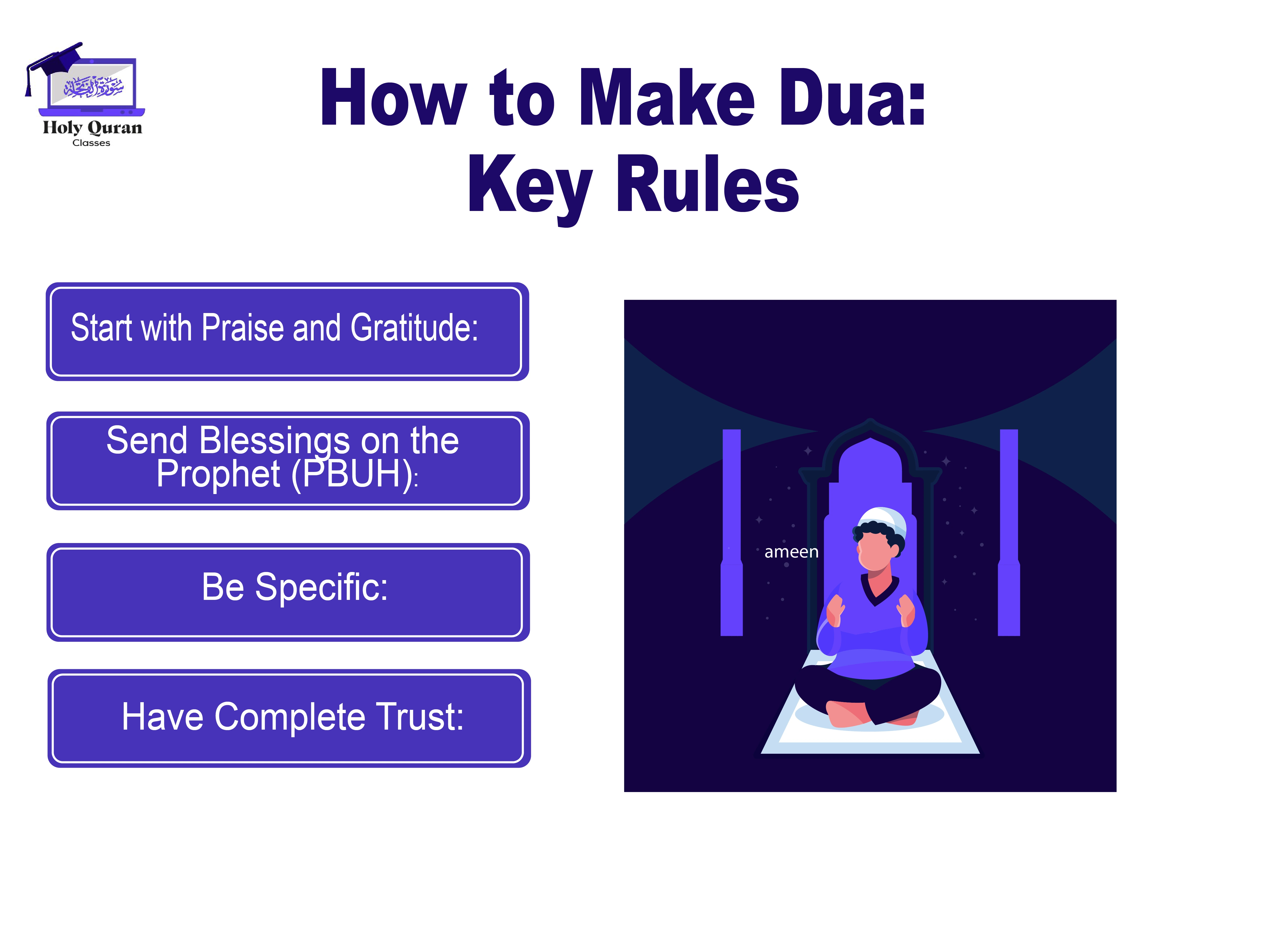
While there is no specific rule for making Dua, there are a few tips that are encouraged to increase the likelihood of it being accepted:
Start with Praise and Gratitude:
Begin by praising Allah and expressing gratitude for His blessings.
Send Blessings on the Prophet (PBUH):
Always send peace and blessings upon Prophet Muhammad (PBUH).
Be Specific:
Mention your needs and desires clearly and sincerely.
Have Complete Trust:
Trust that Allah hears and responds to every sincere Dua.
Conclusion
Dua is an essential part of a Muslim’s life, guiding them toward closeness with Allah and providing spiritual strength in every aspect of life. Whether it is seeking forgiveness, asking for guidance, protection, sustenance, or patience, the Qur'an and Hadith offer a vast collection of supplications that every Muslim can incorporate into their daily lives. For those looking to deepen their understanding of Dua and other key aspects of Islam, exploring resources like Holy Quran Classes
By making Dua regularly, believers open their hearts to divine mercy and enhance their faith, knowing that Allah is always near to those who call upon Him.
Why Choose Us For Learning ?
Online Quran learning solutions
that meet your needs. World's Top Rated Online Quran Classes for Kids and Adults with Native Arab Quran Tutors.
 Learn with Expert Arab Tutors
 Affordable Tuition Fee & Packages
 Schedule of Your own Choice
 Safe & Secure Payment Method
Frequently Asked Questions!
Dua is the act of supplication, where Muslims call upon Allah to seek His guidance, mercy, protection, and blessings. It is a direct communication between the believer and Allah, where one can ask for personal needs, spiritual help, or forgiveness.
Dua is important because it strengthens a believer’s relationship with Allah. It serves as a means of spiritual connection, allowing Muslims to express gratitude, seek assistance, and demonstrate their reliance on Allah for everything.
There is no set number for how often Dua should be made. Muslims are encouraged to make Dua regularly, both in times of ease and difficulty. It can be done at any time of the day, although specific times, such as during prayer or after obligatory prayers, are considered especially favorable.
While Allah has already written the destiny of every individual, it is believed that Dua has the power to change what is decreed, as long as it aligns with Allah's wisdom. The Prophet Muhammad (PBUH) said, "Nothing can change the Divine decree except Dua." (Sunan Tirmidhi)
Dua for Forgiveness (Istighfar):
One of the most frequently mentioned types of Dua in the Qur'an is the Dua for forgiveness. This prayer helps Muslims seek mercy and pardon for their sins, ensuring that they are on a path toward spiritual purification.
"Our Lord, forgive us our sins and remove from us our misdeeds and cause us to die with the righteous." — Surah Al Imran (3:193)
Prophet Muhammad (PBUH) said, "The best Dua for forgiveness is to say: 'O Allah, You are my Lord, there is no deity except You. You created me, and I am Your servant. I am faithful to my covenant and my promise as much as I can.'" (Sahih Al-Bukhari)
Dua for Guidance (Istikhara):
When Muslims face difficult decisions, they turn to Salat Al-Istikhara, a prayer that asks for Allah’s guidance in making the right choices. This Dua is highly emphasized in both the Qur'an and Hadith as a means of ensuring that one's path is aligned with Allah's will.
"Guide us to the straight path." — Surah Al-Fatiha (1:6)
Jabir bin Abdullah narrated that Prophet Muhammad (PBUH) taught them to perform Istikhara in all affairs. He (PBUH) would say: “If any of you is concerned about a matter, then let him pray two units of prayer...” (Sahih Al-Bukhari)
Dua for Protection:
Islam encourages believers to seek protection from evil and harm through regular Duas. These supplications are powerful shields that protect one from the trials of the world, jealousy, evil eye, and other unseen dangers.
"Say, 'I seek refuge in the Lord of daybreak from the evil of that which He created'." — Surah Al-Falaq (113:1-2)
The Prophet (PBUH) said, “Whoever says in the morning and evening: 'In the name of Allah, with whose name nothing on earth or in heaven can cause harm, and He is the All-Hearing, the All-Knowing,' nothing will harm him.” (Sunan Abu Dawood)
Dua for Sustenance (Rizq):
Muslims turn to Allah to seek rizq (sustenance), understanding that all provisions, whether material or spiritual, come from the Divine. Regular Duas for sustenance are not only meant for worldly needs but also for seeking spiritual wealth.
Our Lord, grant us from Yourself mercy and prepare for us from our affair right guidance." — Surah Al-Kahf (18:10)
Anas bin Malik reported that the Prophet (PBUH) said, "Whoever says in the morning: 'O Allah, whatever favor has come to me, it is from You alone. You have no partner.' Allah will bless him in his provisions." (Sunan Abu Dawood)
Dua for Patience and Strength (Istighfar):
Trials and hardships are part of life, and Islam teaches patience (Sabr) as one of the highest virtues. There are numerous Duas in both the Qur'an and Hadith that ask for patience, resilience, and the strength to endure difficult times.
"Our Lord, pour upon us patience and let us die as Muslims in submission." — Surah Al-A'raf (7:126)
The Prophet (PBUH) said, “No one is granted a gift better and more comprehensive than patience.” (Sahih Al-Bukhari)
How to Make Dua: Key Rules
While there is no specific rule for making Dua, there are a few tips that are encouraged to increase the likelihood of it being accepted:
Begin by praising Allah and expressing gratitude for His blessings.
Always send peace and blessings upon Prophet Muhammad (PBUH).
Mention your needs and desires clearly and sincerely.
Trust that Allah hears and responds to every sincere Dua.
Conclusion
Dua is an essential part of a Muslim’s life, guiding them toward closeness with Allah and providing spiritual strength in every aspect of life. Whether it is seeking forgiveness, asking for guidance, protection, sustenance, or patience, the Qur'an and Hadith offer a vast collection of supplications that every Muslim can incorporate into their daily lives. For those looking to deepen their understanding of Dua and other key aspects of Islam, exploring resources like Holy Quran Classes
By making Dua regularly, believers open their hearts to divine mercy and enhance their faith, knowing that Allah is always near to those who call upon Him.
Online Quran learning solutions that meet your needs. World's Top Rated Online Quran Classes for Kids and Adults with Native Arab Quran Tutors.
Dua is the act of supplication, where Muslims call upon Allah to seek His guidance, mercy, protection, and blessings. It is a direct communication between the believer and Allah, where one can ask for personal needs, spiritual help, or forgiveness.
Dua is important because it strengthens a believer’s relationship with Allah. It serves as a means of spiritual connection, allowing Muslims to express gratitude, seek assistance, and demonstrate their reliance on Allah for everything.
There is no set number for how often Dua should be made. Muslims are encouraged to make Dua regularly, both in times of ease and difficulty. It can be done at any time of the day, although specific times, such as during prayer or after obligatory prayers, are considered especially favorable.
While Allah has already written the destiny of every individual, it is believed that Dua has the power to change what is decreed, as long as it aligns with Allah's wisdom. The Prophet Muhammad (PBUH) said, "Nothing can change the Divine decree except Dua." (Sunan Tirmidhi)
Want to continue your learning journey? Check out our other popular courses and take your knowledge to the next level!
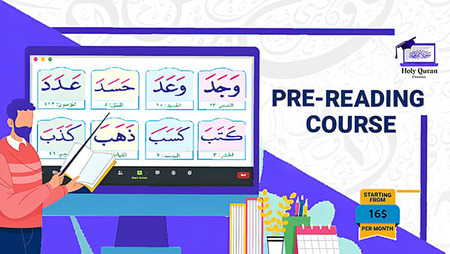
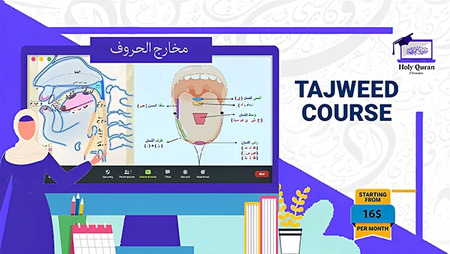



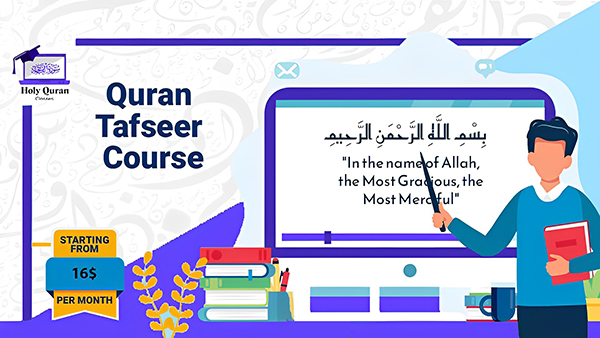

Join The World's Largest Quran Learning Online Program Today!
Still hesitant about quran classes online? Or do you need help to accomplish it? So, why not take advantage of our free trial sessions and discover them yourself? As we provide this service with top rated teachers, we are sure that you will like how our teachers teach and how simple and hassle-free quran online class is.


By subscribing to the newsletter, you will be updated with our latest blogs, promotion packages, or any other updates regarding HolyQuranClasses through emails.